The International Wildland Fire Safety Summit is the gathering for members of the global wildland fire community to focus on how we keep our workforce and communities safe. The Human Dimensions of Wildland Fire Conference aims to advance knowledge and practices related to the social, political, economic, psychological and other human aspects of managing fire prone landscapes.
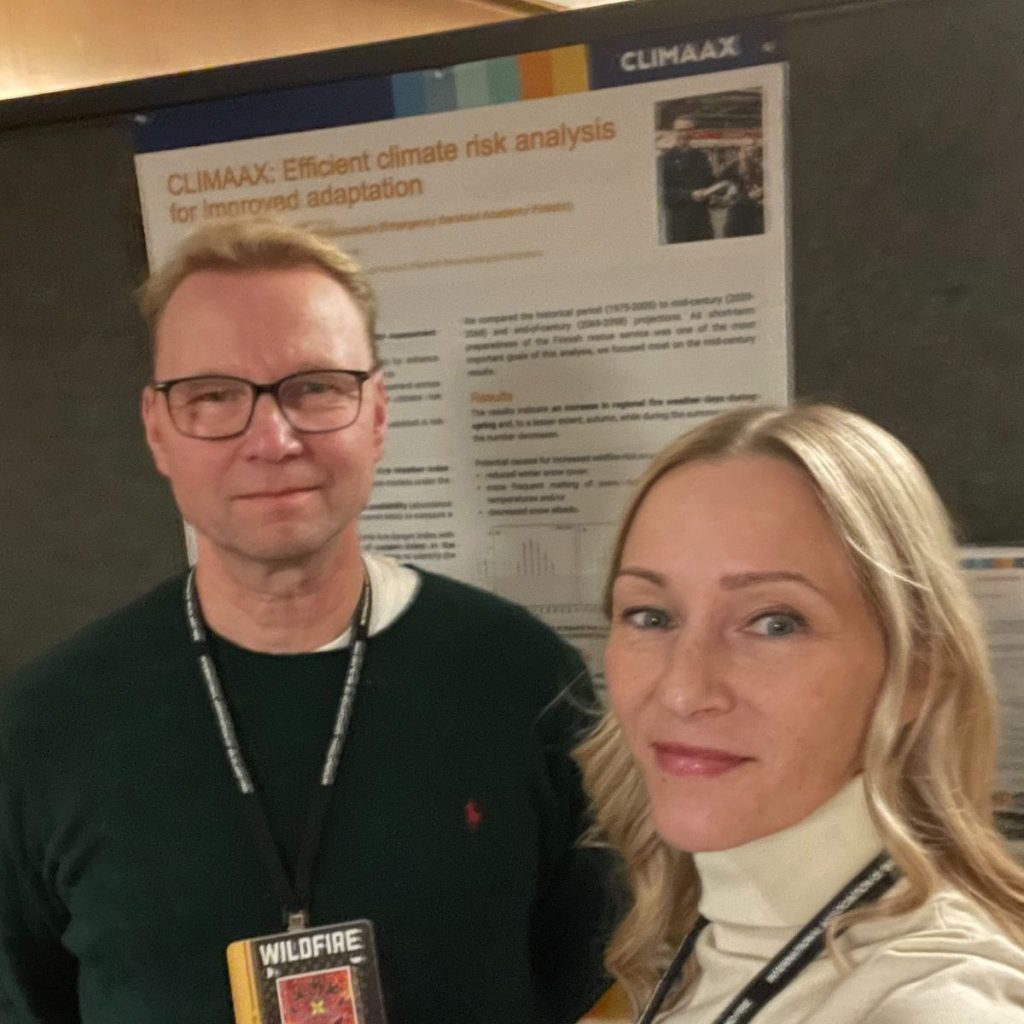
Juha Laitinen and I [Riikka Salmi, Pelastusopisto – Ed. note] had the honor of presenting the poster of the pilot results of project CLIMAAX at this international conference. This conference hosted 400 participants from 15 different countries. The program featured a wide range of presentations and posters covering various themes, along with a strong presence of exhibitors.
We had the opportunity to hear two very impactful keynote speeches. The keynote speaker on the first day, Dr Bhiamie Williamson – Associate Professor at Monash University and Program Lead, National Indigenous Disaster Resilience, raised three important questions about wildfires: What is the problem? What is the problem behind the problem? What could be done about them? Large-scale wildfires leave traumatic scars. Children and other vulnerable groups are especially at risk. Indigenous peoples are among the most affected, and at the same time, we should learn from them when considering the question “What is the problem?”
Colonization has brought settlement and altered nature and the environment in ways that make them more susceptible to wildfires. At the same time, it has also made people more vulnerable to natural forces. This issue is not limited to wildfires – it also applies to floods.
The keynote speaker provocatively suggested that one major issue is, so to speak, deafness and blindness. We keep pushing increasingly powerful solutions to combat wildfires onto the market. We focus only on the problem itself, not on its root causes. So, what could be done about this? One major step would be to acknowledge the truth about colonization.
We should learn more from Indigenous peoples and their ways of respecting nature – fire, earth, and water. All of these are part of the planet and should be accepted and honored. Floods and wildfires will become more intense in the future – that is a recognized fact. Therefore, the question should rather be: how can we make people safer for the planet? The speaker concluded their talk with lyrics from Bruce Springsteen’s song “Dancing in the Dark”.
You can’t start a fire
You can’t start a fire without a spark
This gun’s for hire
Even if we’re just dancing in the dark
The second keynote speaker, Bethany E. Hannah – Executive Director, American Wildfire Experience & Wildfire International, delivered a deeply touching speech in which she shared her personal experience of a large-scale wildfire. In her talk, Hannah emphasized trust and human relations. She also echoed the first speaker’s message by highlighting the human dimension – urging the audience to reflect on why, in the context of wildfires, the focus tends to be more on technology than on human interaction. The answer is here; connect with people’s curiosity.
Hannah shared several testimonies from people around the world. A common theme that emerged was the building of trust through the acknowledgment that there are no clear answers. The speeches also highlighted the important role and position of women as firefighters, the value of volunteers, and the importance of learning from one another; Accelerating trust, Accelerating co-operation and solutions. “Point on the solution, not the problem”. Wildland fire standards should apply local environment and reality in frontline. The coordination of fire suppression management should be comprehensive, because available resources are limited. One barrier to progress is the reluctance to admit mistakes. When we create connections, we create solutions.
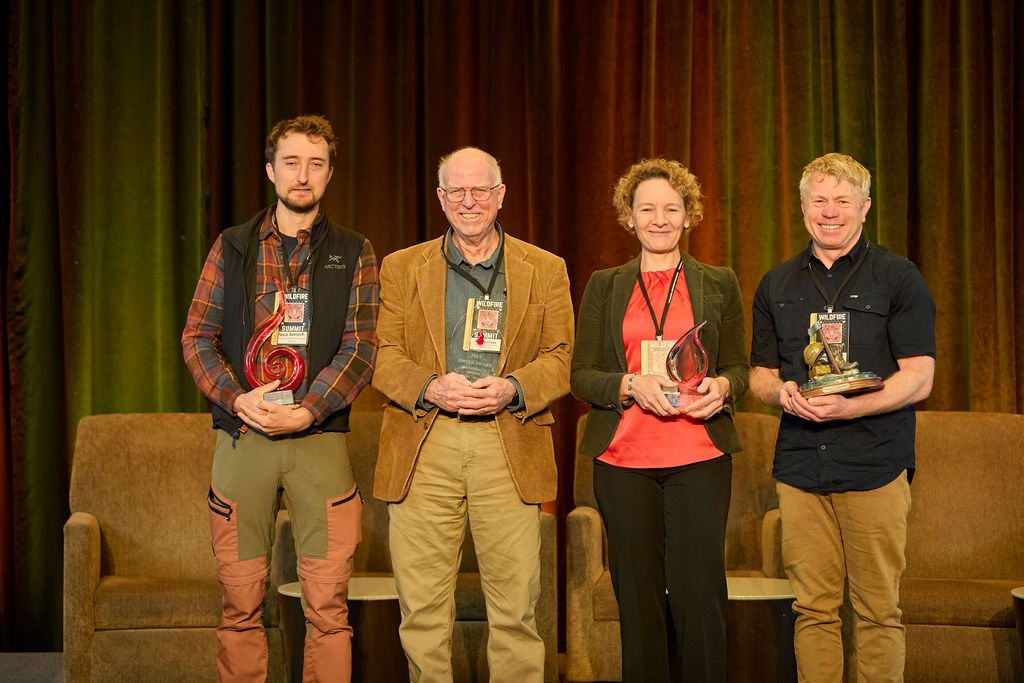
At the same conference, four annual IAWF Award winners were recognized for their achievements. Nico Semsch from Germany received the 2025 Early Career Award in Fire Operations, Dr. Stephen Pyne was honored with the 2025 Ember Award for Excellence in Wildland Fire Science, Juliane Baumann from Germany received the 2025 Firebreak Award for Excellence in Fire Management, and Steve Lemon from British Columbia was awarded the 2025 Wildland Fire Safety Award. (by Riikka Salmi, Pelastusopisto)