
In the last ASPECT User Forum, taking place on 23–24 March 2026 under the title Advancing climate adaptation with seamless and tailored climate predictions, Frederiek Sperna Weiland, coordinator of the EU-funded CLIMAAX, will deliver the opening keynote on 23 March at around 14:25 CET. Drawing on CLIMAAX’s experience, the keynote will offer concrete examples of how climate information services can support, inform, and strengthen decision-making processes, setting the scene for two days of discussion on climate adaptation and resilience.
As climate risks grow in complexity, the demand for climate information that is both tailored to user needs and consistent across timescales is increasing. Sectors such as agriculture, public governance, and disaster risk management require climate insights that connect short-term forecasts with longer-term outlooks, enabling informed and forward-looking decisions. Seamless climate predictions play a key role in meeting this need by transforming scientific data into actionable knowledge.
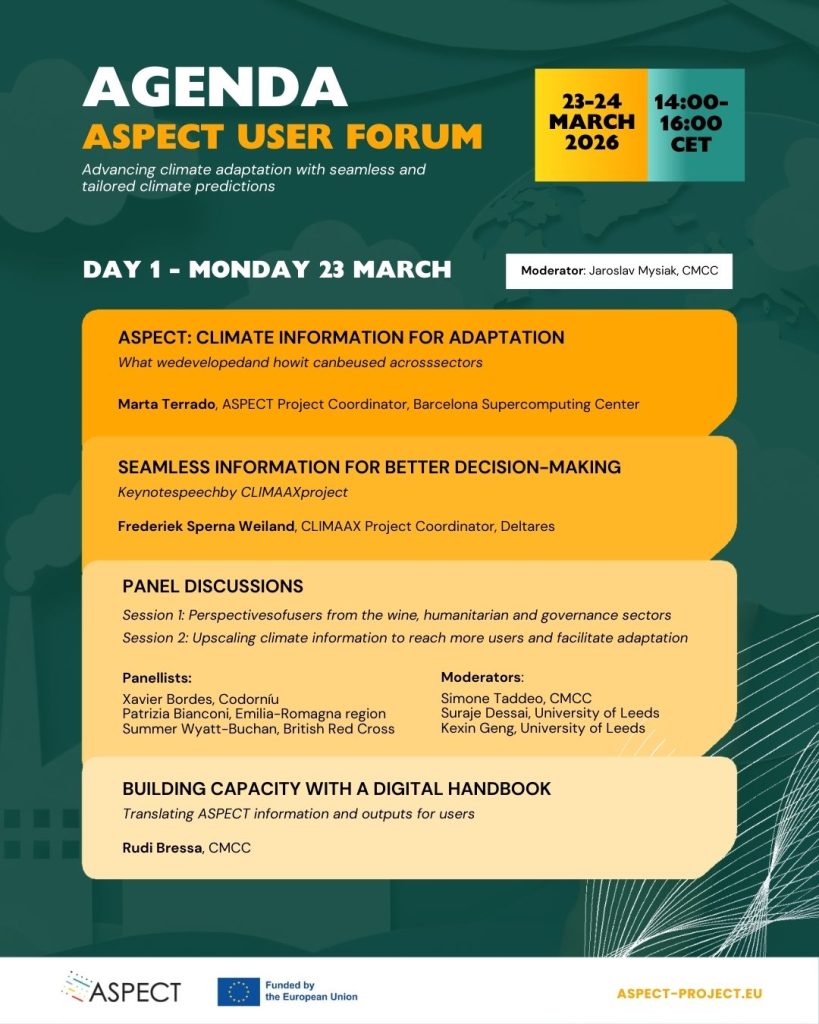
Over the past three years, the ASPECT project has developed innovative approaches to bridge seasonal, decadal, and multi-decadal climate predictions. These approaches have been applied to real-world case studies and supported by continuous dialogue between scientists and users, ensuring that advanced climate science translates into practical and usable climate services.
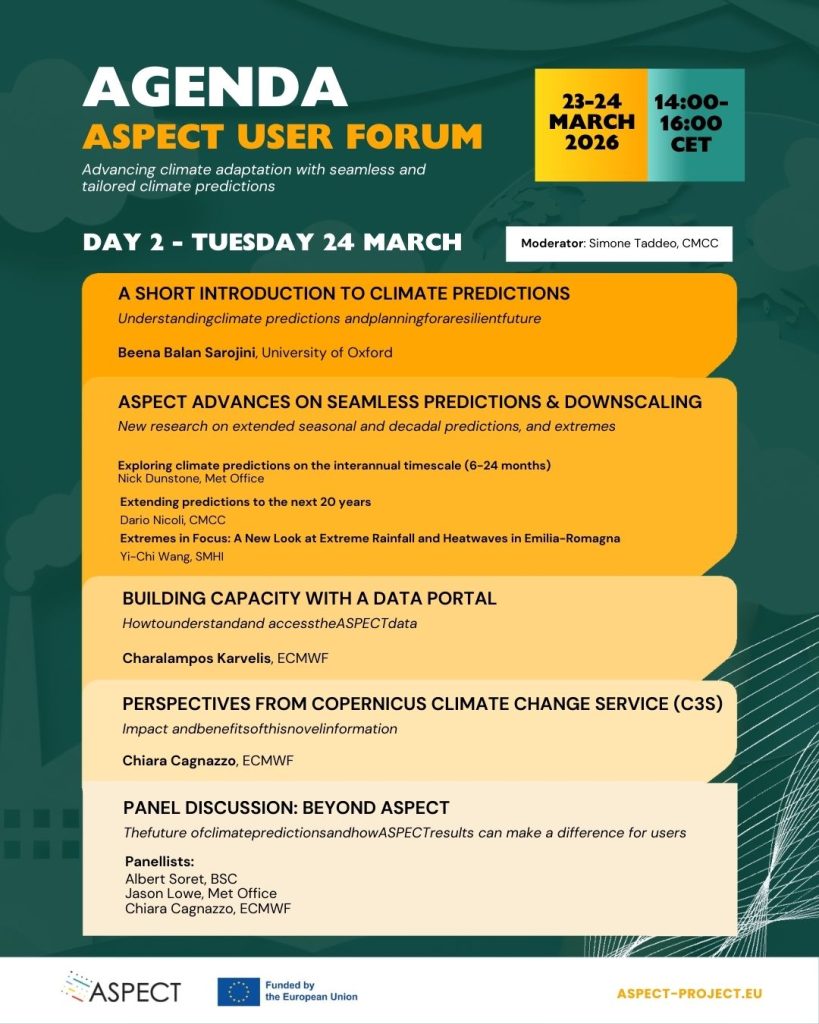
Alongside its scientific work, ASPECT has focused on strengthening capacity across a wider community of practice, promoting the understanding and uptake of state-of-the-art climate prediction tools and data. The annual User Forums play a central role in this process, bringing together scientists, users, and decision-makers to consolidate results and jointly shape the future of seamless climate services.
The fourth and final ASPECT User Forum, held online on 23 and 24 March 2026, will showcase the project’s latest scientific advances, explore benefits for real-world users, and provide a space for exchange on how seamless climate predictions can contribute to a more climate-resilient future.